
區域供冷
As global temperatures continue to rise and the demand for cooling energy increases, we must seek cleaner solutions to cool our buildings and cities. District cooling is a promising option to harness free cooling from sea water and air. It can efficiently cool entire communities from a centralized chiller plant and provide free cooling to large geographical areas. By eliminating the need for individual chillers in every building, district cooling can significantly reduce environmental impact.

Why Alfa Laval in district cooling?
- Alfa Laval has been a pioneering force in plate heat exchangers for almost a century, leading the industry in innovation and sustainability.
- We recognize the growing importance of district cooling and have developed solutions specifically tailored to your needs.
- Our heat exchangers excel in district cooling, saving costs, enhancing energy efficiency, and providing superior cooling performance.
How district cooling works
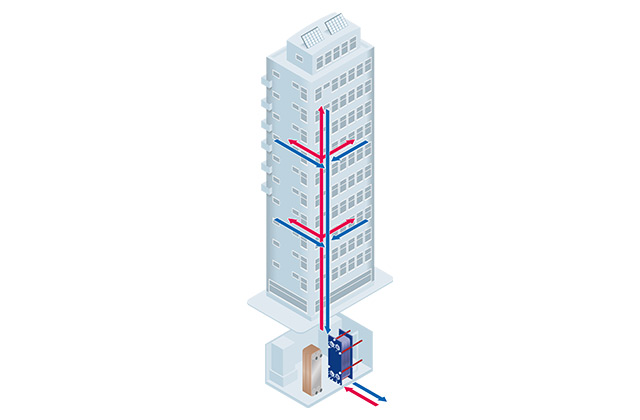
District cooling efficiently distributes cooling water from a centralized substation to local buildings using heat exchanger technology. The heat exchangers have two main purposes: Optimizing energy use by controlling water consumption and acting as pressure-breakers to control damage in case of leaks.
The substation consists of a control unit, control valve, and heat exchangers. The control valve regulates water flow, while the heat exchangers modulate the temperature and capacity for each building. An energy meter measures flow rate and temperature to calculate water consumption and final billing.
Free cooling from river or sea water
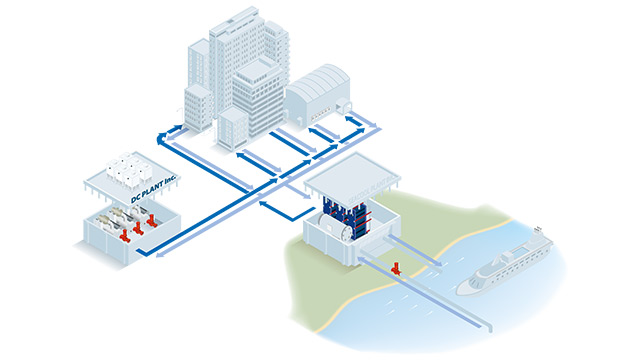
Utilising sea and river water for free cooling saves significantly more energy than traditional chillers. It also reduces the use of harmful refrigerants and fossil fuels, making it an environmentally friendly alternative.
Alfa Laval's plate heat exchanger technology is the ideal solution for safely utilizing various water sources, as it isolates the chilled water loop from sensitive equipment, eliminating the potential for corrosion, scaling, or unwarranted maintenance. The compact design of our plate heat exchangers offers more efficient cooling with minimal fuss.
Excess heat in chiller plants can save money and decrease carbon footprint
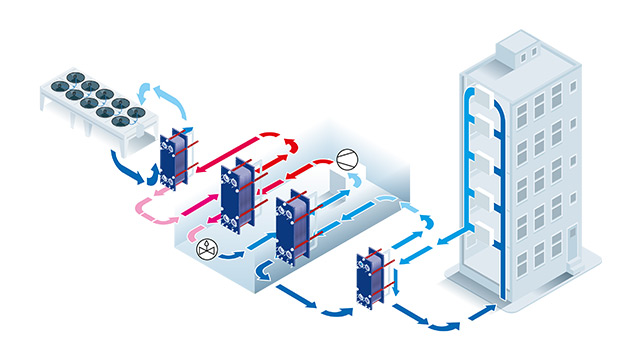
A chiller plant's primary function is to produce cold, but it also generates excess heat as a by-product. Reusing this excess heat is a great solution for space heating and domestic hot water, as it reduces fossil fuel consumption and energy bills at the same time.
Absorption chiller – produce efficient cooling from heat
In settings where district heating and excess heat are released at elevated temperatures, a heat-driven absorption chiller can provide efficient cooling. With this approach, you have access to free cooling from your existing process without depending on water as your cooling source. This reduces your electricity usage and conventional refrigerant consumption.
How an absorption chiller works
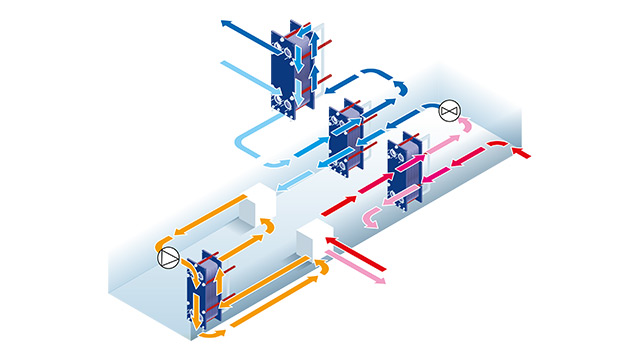
Inside the evaporator, refrigerant absorbs heat from the connected system, and a heat exchanger helps cool the air conditioning circuit. The refrigerant then enters the absorber in the form of low-pressure vapor, which is absorbed by a liquid solvent (usually lithium bromide).
A pump increases the pressure of the refrigerant, before it proceeds to an interchanger, where it is preheated (often using a plate heat exchanger). The resulting high-pressure vapor is then directed to the condenser, where heat is released during the refrigerant's condensation process.
顧問?系統整合商?
顧問們請不要錯過,憑藉在熱交換業界數十年的經驗,阿法拉伐為當今的供暖和降溫挑戰提供了豐富的知識底蘊。您可以在阿法拉伐找到關於能源效率以及天然冷媒等方面的複雜問題的解答,幫助您更輕鬆地找到適合應用的技術工具。
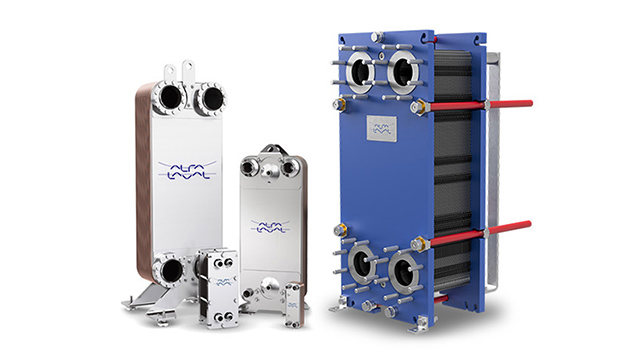
AHRI認證的熱交換器,確保可靠熱性能
我們取得全球對熱性能的AHRI(空氣調節、暖氣和冷凍協會)第三方驗證的認證,為您提供獨立保證,確保板式熱交換器將按照製造商公布的性能指標執行。阿法拉伐提供經過AHRI認證的墊片式板式熱交換器、銅焊式板式熱交換器和擴散焊全不鏽鋼板式熱交換器。
Case story

Keeping The Louvre and Mona Lisa cold
Over the years, Alfa Laval has become a true partner and has contributed, thanks to its expertise and technology, to the performance of the Climespace energy network, which is the first district cooling system in Europe and one of the biggest in the world."
Jean Levezac, Head of Cluster Connections/Substations at Climespace Engineering
設備效能,歷久彌新
效能不佳的熱交換器,將對現場安全、產品品質和能源成本有負面影響。設備故障可能會導致代價高昂的非預期性停機和重大的生產損失。藉由定期檢測和主動維修保養,讓您可安心使用設備,輕鬆掌握運轉狀況。