
CBM
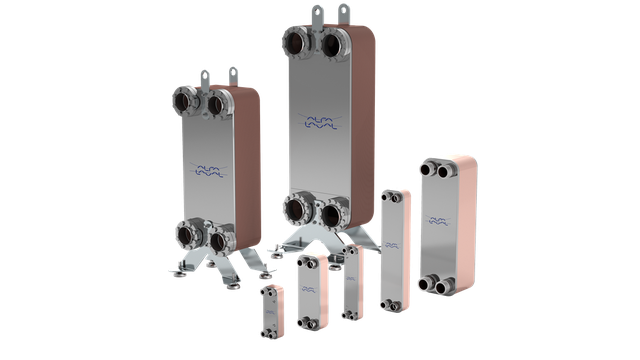
The Alfa Laval CBM line of copper-brazed plate heat exchangers for marine applications offers an ideal solution for demanding installations with limited space. The gasket-free design ensures reliable performance, with stainless-steel plates brazed in a furnace using thin copper foil in between. CBM heat exchangers can be used for duties such as BOG (boil off gas) heating and cooling, natural gas heating, oil heating, heat recovery, refrigeration intercooling and CO2 refrigeration conditioning.
Robust, compact heat transfer performance
- Compact and efficient plate-type heat exchanger
- Flexible temperature range from -196°C to +225°C and design pressures up to 120 bar
- Low hold up volume
- Type-approved by all major class societies
- The range includes models: CBM30, CBM110, CBMH200, CBM400, ACMH220, AXPM112 and Heatpac CBM
CBM heat exchangers can support design temperatures from cryogenic (-196°C) up to 225°C, at a maximum design pressure of 51 bar. Even higher pressure applications are covered by the AXPM models, which can withstand extreme pressures reaching 120 bar in a temperature range from -45°C to 225°C, due to its reinforced external carbon-steel frame plates.
Heatpac CBM is a predefined range of CBM30 and CBM110 heat exchangers for fuel – and lubrication oil preheating and heat recovery applications. These includes standard insulation and counterflanges with gaskets and bolts.

The easy way to reduce your energy costs and increase energy efficiency
A refund is just the start of your savings potential with the new exchange programme. Alfa Laval’s innovative heat exchanger technology will significantly increase the energy efficiency of your processes. That means drastically lower power consumption and carbon emissions, along with a significant reduction in your long-term operating costs.
Two media at different temperatures flow on either side of thin corrugated stainless-steel plates that are stacked on top of each other. The two media flow in a countercurrent flow through alternate channels and are held within the plate pack by a fusion-bonded seal around the edge of the plates. The points at which the plates are in contact with each other are also bonded with the same technology, reinforcing the pack against the pressure of the media inside.
The countercurrent flow makes it possible to extract heat efficiently even when there are only extremely small differences between the temperatures of the hot and cold media. This results in notable energy cost savings. In some systems, co-current flows re also possible. The product is optimized for marine applications.
View the animation to learn more.
在全球航運邁向低碳轉型之際,越來越多的船東選擇液化天然氣(LNG)做為船舶燃料,以因應國際法規要求,並確保營運韌性與競爭優勢。
LNG做為低碳燃料的優勢在於燃燒時的潔淨特性。由於天然氣液化前處理程序可去除硫化物、水分及其他雜質,燃燒時幾乎不產生硫氧化物。相較於傳統燃油,燃燒時可降低20~25%的二氧化碳排放。此外,低溫液化後的天然氣體積可縮小約600倍,大幅提升儲存與運輸效率。
無論您已採用LNG燃料,或仍在評估階段,Alfa Laval 都是您值得信賴的技術夥伴。憑藉超過五十年的燃氣處理應用經驗,從初期的氣體運輸船到今日以 LNG作為船舶燃料應用,Alfa Laval 具配套設備、專業應用知識與服務,可協助產業用戶充分發揮LNG的優勢,並確保安全、提升效率、減少碳排。